
The problem: deliveries run on phone calls and paper
Local delivery companies often run on phone calls, messages and paper delivery notes. The business client calls to place an order, then calls again to know where it is. The driver gets the day's route on a sheet of paper. The signed delivery note comes back to the office days later, if it is not lost.
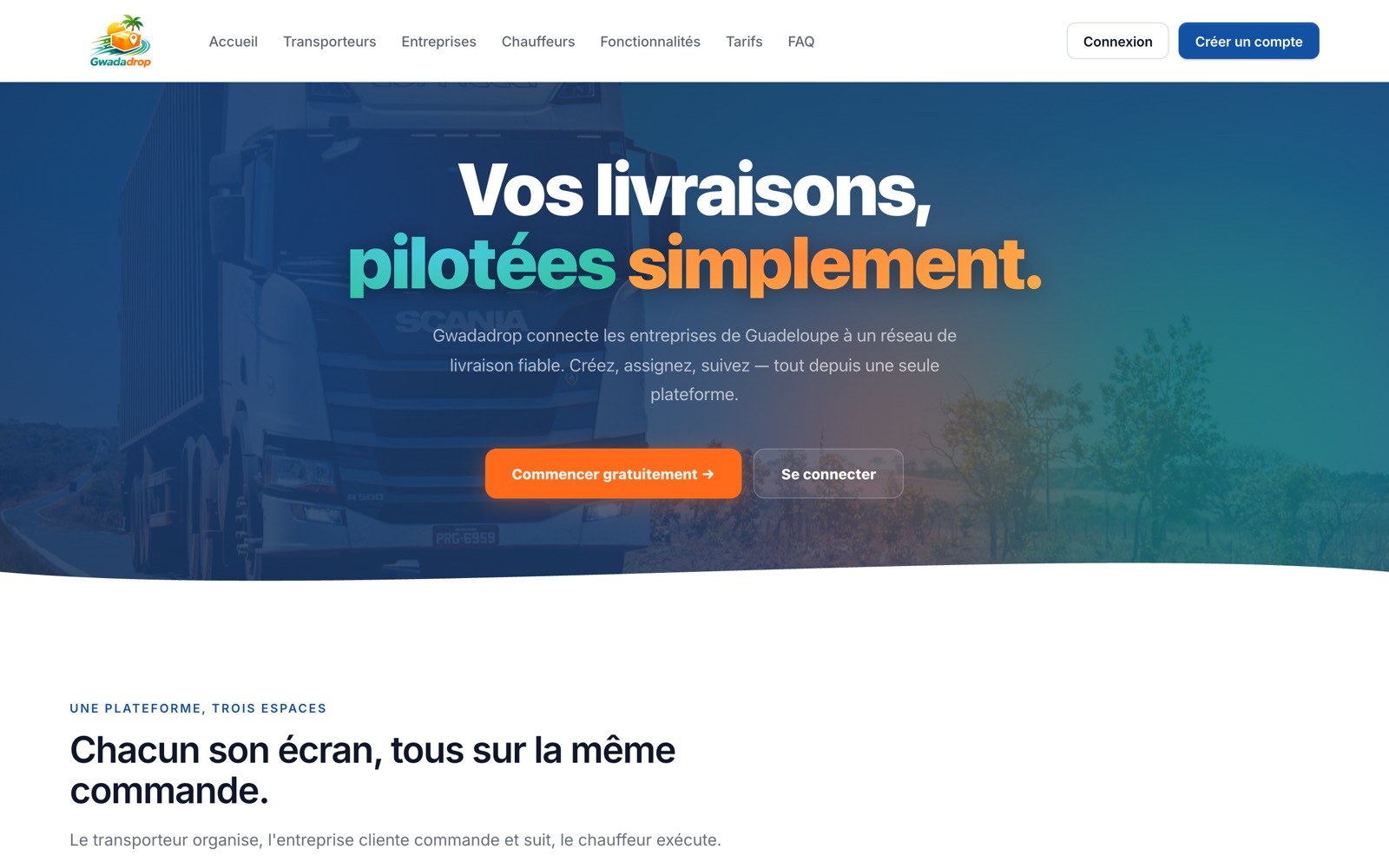
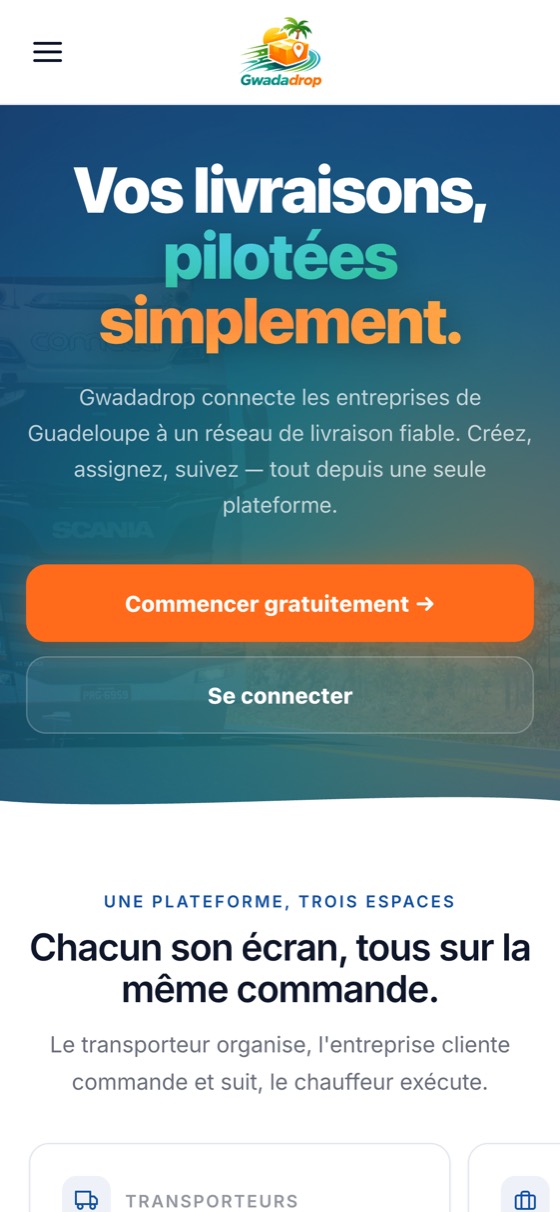
Gwadadrop is the SaaS platform we designed to replace that chain with a single shared system. It was built in Guadeloupe, where we are based, for carriers and the businesses that rely on them.
Three spaces in one platform
Carrier space
- Orders, clients, drivers, vehicles and delivery notes in one place, with unlimited clients and drivers.
- Orders filtered by status, sorted, and arranged in a custom running order.
- Driver assignment, Express priority and recurring orders scheduled once.
Business client space
- Place an order by filling in a few fields.
- Follow each order's status in real time and message the carrier in a thread attached to the order.
- Retrieve signed delivery notes at any time.
Driver space
- The day's deliveries and the itinerary, with links to Google Maps or Waze.
- Signatures captured on screen at collection and delivery, including a single signature for a grouped collection.
- Clock in and out at the start and end of service. Nothing to install, and each driver sees only their own deliveries.
Proof of delivery, generated automatically
Every collection and delivery can be signed on the driver's phone, with the signer's name and the date. The signed delivery note is generated automatically and archived, so the carrier and the client find it in seconds instead of searching through paper.
| Status | What it means |
|---|---|
| Pending | The order has been placed by the client |
| Processed | The carrier has accepted and scheduled it |
| Collected | The driver has picked up the goods, with a signature if required |
| In delivery | The goods are on their way |
| Delivered | Delivery completed and signed, delivery note archived |
Designed with the people who use it
Gwadadrop is used every day by carriers and their clients, and the interface evolved with their feedback: a more professional look for the dashboards, clearer statuses, and workflows adjusted to the realities of the field, such as editing an order that has several pickup points.
On the business side, carriers subscribe online through Stripe, a client joins a carrier using the carrier's key (and the carrier approves each request), and transactional emails keep everyone informed when an order is created or updated.
Built for the field
Drivers use the platform outdoors, in a truck, between two stops. The driver space is therefore designed for one-handed use on a phone: large buttons, the next delivery at the top, navigation one tap away and signatures captured directly on screen. The carrier, at the office, gets the opposite: dense lists, filters and statuses to manage dozens of orders at once.
What this project shows
Gwadadrop is a typical operations platform: several types of users, mobile use in the field, documents with legal value and a need for reliability. If your business runs on calls, spreadsheets and paper forms, a custom web application can often replace them. Our guide to SaaS development costs explains what drives the budget, and you can contact us to talk about it (page in French; we reply in English).
Updated November 13, 2026